snıff

Bullmastiff

Life expectancy
10.2 years
95% CI 9.9 to 10.5 · McMillan 2024, n=2,188
Highest allele frequency
Canine Multifocal Retinopathy 1
9.1% of gene copies · 209 dogs tested · Donner 2023
Behind this page
31 dogs
behind the atlas figures · an early sketch · 209 tested for variants

Bullmastiffs have a cited life expectancy of 10.2 years (McMillan 2024 / VetCompass, n=2,188, 95% CI 9.9 to 10.5). The tested variant with the highest allele frequency is Canine Multifocal Retinopathy 1, at 9.1% among the 209 Bullmastiffs tested (Donner 2023; gene copies, not dogs), then Degenerative Myelopathy (2.2%) and Cystinuria Type I-A (1.9%). 31 dogs stand behind the atlas figures here, so treat this page as an early sketch.

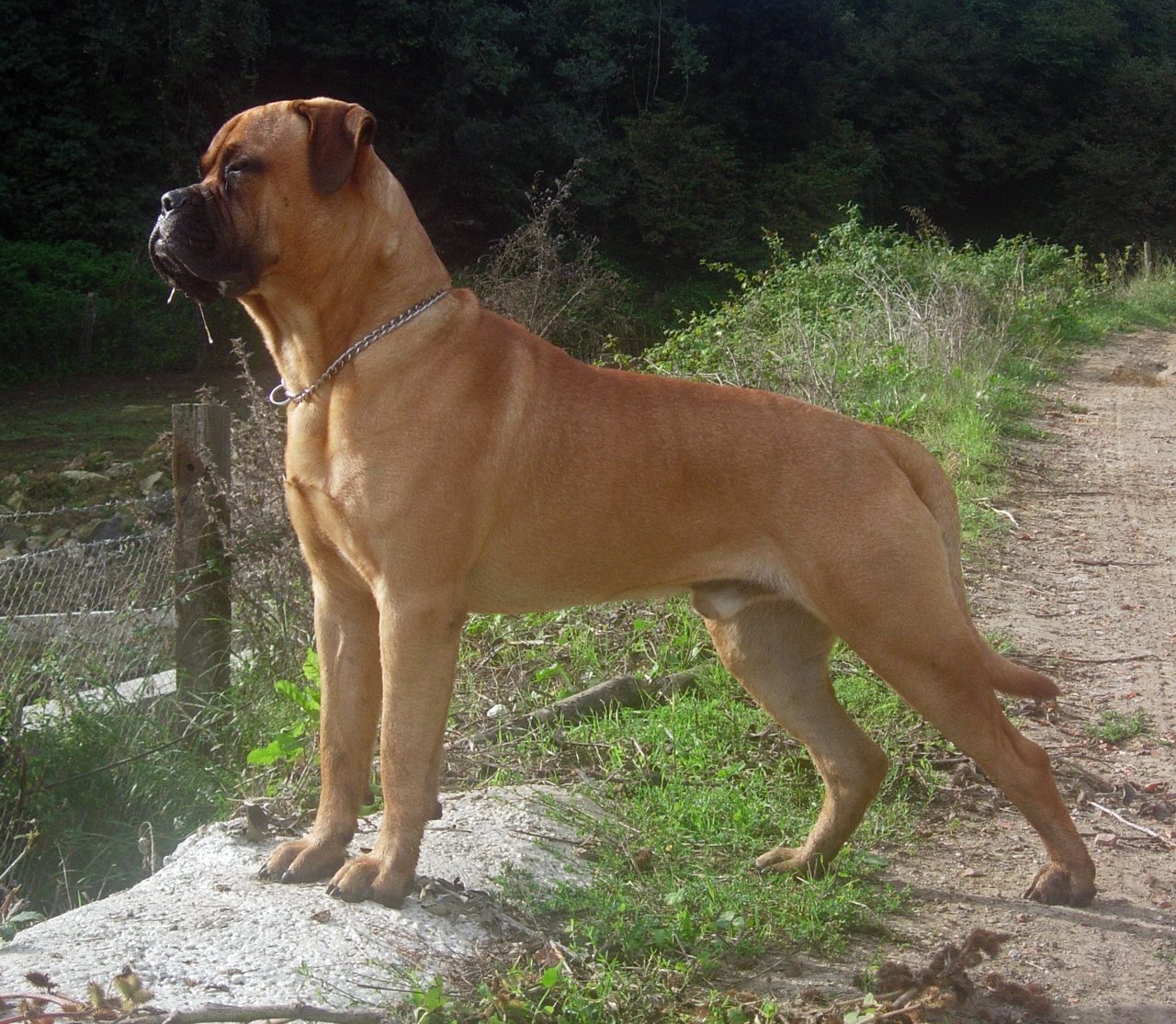
Bullmastiff
Photo: Fausto Moreno · CC BY-SA 3.0 · Wikimedia
Mendelian-disease genetics

Which disease variants turn up in Bullmastiffs?

From a panel of 250 Mendelian-disease variants screened in 1,054,293 dogs (Donner et al. 2023), 4 turn up in Bullmastiffs at observable frequency. The figure beside each is its allele frequency. Of the gene copies tested in this breed, the share that carry the variant. Every dog carries two copies, so this is not the share of dogs. It is not clinical risk. Most recessive variants require two copies for disease expression; many dominant variants show incomplete penetrance. Read this as a population fingerprint of what's in the gene pool, not a per-dog prediction.

low frequency band 9.1%
n = 209 dogs · 1 variant tested · OMIA:001444-9615 · omia.org →
BEST1what this gene does

BEST1 is a gene that helps maintain the health of the retina, the light-sensitive layer at the back of the eye. It plays a role in keeping the cells in the retina functioning properly.

For your dog: If your dog is from a breed known to carry BEST1 variants, it’s worth discussing retinal health with your vet, especially if you notice any vision changes.

Degenerative Myelopathy (DM)
Autosomal recessive
low frequency band 2.2%
n = 209 dogs · 1 variant tested · OMIA:000263-9615 · omia.org →
SOD1what this gene does

SOD1 is a gene that helps protect cells from damage caused by harmful molecules called free radicals.

For your dog: If your dog is a carrier of SOD1 variants, it's worth discussing with your vet, but remember carrier status doesn't mean your dog will get the disease.

low frequency band 1.9%
n = 209 dogs · 3 variants tested · OMIA:000256-9615 · omia.org →
SLC3A1what this gene does

SLC3A1 is a gene that helps transport certain amino acids in the kidneys. It plays a key role in preventing the buildup of cystine, which can form stones.

For your dog: If your dog is from a breed known to carry SLC3A1 variants, it’s worth discussing cystinuria risks with your vet, especially if urinary issues arise.

Dental Hypomineralisation
Autosomal recessive
low frequency band 0.24%
n = 209 dogs · 1 variant tested · OMIA:002015-9615 · omia.org →
FAM20Cwhat this gene does

FAM20C is a gene that plays a key role in the mineralization of teeth, helping them develop properly and stay strong.

For your dog: If your dog is from one of these breeds, it's worth mentioning FAM20C to your vet when discussing dental care, but being a carrier doesn't mean your dog will have problems.

Source: Donner J et al. 2023. Genetic prevalence and clinical relevance of canine Mendelian disease variants in over one million dogs. PLOS Genetics 19(2):e1010651 · Evidence: Limited (DTC ascertainment, tag-SNP proxy) · Confounding MEDIUM · License CC-BY-4.0 · Phene IDs from OMIA (Sydney School of Veterinary Science, The University of Sydney; DOI 10.25910/2AMR-PV70).
Sample size in this breed: 209 dogs from the Donner 2023 cohort.
In plain terms

What these results mean for a Bullmastiff

About 2 in every 100 copies of this gene in the 209 Bullmastiffs tested carry this change (Donner 2023).

  • DM slowly damages the spinal cord in adult dogs, until the back legs stop working. Nothing yet can stop it.
    OMIA 000263-9615

    “This is an adult onset degeneration of the spinal cord that progresses to paraplegia and tetraparesis. There is no successful treatment. A genetic test is available.” OMIA 000263-9615

  • Two copies of the SOD1 gene change mean a dog is at risk, not that it will get sick. Some dogs with two copies never do.
    OMIA 000263-9615

    “some homozygous mutant dogs had no signs of degenerative myelopathy, which suggests incomplete penetrance or other causative loci” OMIA 000263-9615

  • One copy makes a dog a carrier. In the study that found this change, every dog with DM that was tested had two copies.
    OMIA 000263-9615

    “All affected dogs tested were homozygous mutant.” OMIA 000263-9615

What to do
A DNA result isn't a diagnosis. If the way your dog walks changes, take that and the result to your vet.

Not tested, or a mix
Without a test, no one can tell how many copies your dog has. How common it is in a breed says nothing about one dog.

About 2 in every 100 copies of this gene in the 209 Bullmastiffs tested carry this change (Donner 2023).

  • The kidneys can't hold on to cystine, one of the building blocks of protein. It can form crystals and stones that block the flow of urine.
    OMIA 000256-9615

    “Cystinuria, type 1 - A is an inherited defect that causes failure of reabsorption of cystine in the proximal renal tubule, leading to cystine precipitation in the urine. Formation of crystals and calculi lead to urolithiasis and urinary tract obstruction.” OMIA 000256-9615

What to do
If your dog is straining to pee, or passing little or none, see a vet the same day.

Not tested, or a mix
Without a test, no one can tell how many copies your dog has.

Which Mendelian variants matter most for Bullmastiffs?

The Mendelian-disease table above lists variants screened in 209 Bullmastiffs (Donner 2023). Four rise above the background noise of rare recessive carriers, though all are low-frequency in this breed.

Canine Multifocal Retinopathy 1 (CMR1)

Canine Multifocal Retinopathy 1 is an autosomal-recessive retinal condition caused by variants in a gene discovered in Mastiff-related breeds. In Bullmastiffs the figure below is an allele frequency from Donner 2023, not a case series in the breed. The condition has not produced a single phenotype-confirmed case in the Donner 2023 cohort of 209 Bullmastiffs. Retinal lesions are the canonical sign in affected breeds, but expression in Bullmastiffs remains unconfirmed. The variant’s allele frequency among tested Bullmastiffs is 9.1% (Donner 2023) of the variant (n=209).

No dogs in the phenotype-confirmed cohort expressed the disease, which suggests either incomplete penetrance or that homozygous affected individuals are rare enough that none appeared in the study sample. Testing is available through commercial DNA panels.

Dental Hypomineralisation

Dental Hypomineralisation is an autosomal-recessive condition affecting tooth enamel formation, first described in the Border Collie. In Bullmastiffs the figure below is an allele frequency from Donner 2023, not a case series in the breed. The allele frequency is 0.24% (Donner 2023, n=209). Both conditions are sufficiently rare in the breed that they do not materially change breeding or screening decisions for most breeders.

How should I test my Bullmastiff?

A breed-specific panel from a CLIA-accredited lab covering CMR1, degenerative myelopathy, and cystinuria Type I-A provides the highest-yield screening for breeding stock. The allele frequencies are low enough that testing is more useful as a genetic-transparency step than as a population-level risk mitigation.

What should I feed a Bullmastiff?

Bullmastiffs go from 1 pound at birth to 110 to 130 pounds at adulthood. The growth rate is so fast that the calcium-to-phosphorus ratio in the puppy formula is the single most important food decision an owner makes. Deviation from the optimal range during the first year of life increases the lifetime risk of orthopedic disease, and that damage is irreversible.

Large-breed puppy formulations are non-negotiable. The National Research Council’s 2006 nutrient standard for large-breed puppies specifies a calcium-to-phosphorus ratio between 1.1:1 and 2:1 (NRC 2006). Most adult and all-life-stage kibbles exceed this range. A Bullmastiff puppy fed adult kibble receives excessive calcium, which disrupts bone remodeling and predisposes to hip dysplasia, elbow dysplasia, and developmental orthopedic disease. Use a large-breed puppy formula from a manufacturer that runs AAFCO growth trials for large breeds.

Transition to adult food at 12 to 14 months, not 18 months. Bullmastiffs generally reach skeletal maturity by 12 to 14 months, earlier than the very largest breeds. Staying on puppy formula beyond 12 months risks overfeeding calories and calcium once growth has substantially slowed.

Weight management matters more in this breed than in most. The OFA reports hip dysplasia in Mastiff-related breeds at notable rates (ofa.org breed statistics). No published Bullmastiff-specific prevalence figure exists, but the breed’s size and structure place it in a higher-risk category. Adult-life leanness reduces the mechanical load on dysplastic joints and extends functional lifespan. Body condition scoring at every vet visit is the baseline.

The breed’s cited life expectancy is 10.2 years (McMillan 2024 / VetCompass, n=2,188), which is typical for a 120-pound breed. Senior-life feeding should shift toward joint support (glucosamine, adequate omega-3) and calorie restriction to prevent obesity-driven decline in the final years.

What we don’t know

The Bullmastiff atlas contains 31 dogs, one of the smallest cohorts in the dataset. That sample size is insufficient to detect rare Mendelian variants or to settle questions about disease prevalence beyond the four variants in the substrate. The breed’s true genetic architecture remains unmapped.

We do not yet know which Bullmastiffs carrying the CMR1 variant (allele frequency 9.1%, Donner 2023) are at genuine risk for vision loss and which are silent carriers. The zero phenotype-confirmed cases in the study sample could mean either that the penetrance is genuinely low, or that the phenotype is subtle enough to have gone undetected in the dogs that were studied.

Cancer and dilated cardiomyopathy are reported in Bullmastiffs by individual breeders and veterinarians, but published prevalence data do not exist. The honest summary is that no breed-specific epidemiology has been published for either condition, so predicting risk or feeding to prevent it remains speculative for this breed.

Frequently asked questions about Bullmastiffs

How long do Bullmastiffs live? Cited life expectancy is 10.2 years (McMillan 2024 / VetCompass, n=2,188, 95% CI 9.9 to 10.5). Large-breed dogs age faster than small breeds, and Bullmastiffs are no exception. Lifespan varies, and the upper range for the breed is not well documented in published studies.

What is the most common genetic disease in Bullmastiffs? Canine Multifocal Retinopathy 1 is the most common genetic variant by allele frequency, at 9.1% (Donner 2023, n=209). No phenotype-confirmed cases appeared in the study cohort, which means the condition is either very rare in expression or has low penetrance.

Should I do a DNA test on my Bullmastiff? For breeding stock, testing for CMR1, degenerative myelopathy, and cystinuria Type I-A is reasonable as a transparency measure. The allele frequencies are low, but knowing your dog’s status prevents surprise carrier-by-carrier pairings.

Are Bullmastiffs good with kids? Bullmastiffs were originally bred to guard estates and have a protective temperament. Many are gentle with family children, but they are large, powerful dogs that require early socialization and supervision with small children. Breed-club resources emphasize that supervision is essential.

What is the best diet for a Bullmastiff puppy? A large-breed puppy formula with a calcium-to-phosphorus ratio between 1.1:1 and 2:1 is essential (NRC 2006). Adult or all-life-stage kibbles contain too much calcium for growing giant-breed puppies and increase the lifetime risk of hip and elbow dysplasia.

Do Bullmastiffs have breathing problems? Bullmastiffs are not brachycephalic like Bulldogs or French Bulldogs. They have normal muzzle proportions and do not typically have upper-airway obstruction. They are prone to overheating in warm weather and should not be exercised in heat.

What health conditions should I screen for before breeding? OFA hip and elbow screening before breeding is a standard recommendation for large breeds; check the Mastiff Club of America website (mastiff.org) for the current breed health protocol. The four Mendelian variants in the substrate (CMR1, degenerative myelopathy, cystinuria, and dental hypomineralisation) are each low-frequency, but a breed-specific DNA panel provides a baseline genetic transparency.

Are Bullmastiffs prone to bloat? Bloat (gastric torsion) is a risk in deep-chested, large-breed dogs and has been reported in Bullmastiffs. Feeding multiple small meals rather than one large meal, avoiding exercise immediately after eating, and knowing the signs of bloat (distended abdomen, unproductive retching, restlessness) are recommended precautions.

Names & origins

Identified as Bullmastiff (VBO:0200261) in the Vertebrate Breed Ontology (Mullen et al. 2025, CC-BY 4.0) · registry IDs FCI 157 · iDog 59.

For researchers Population genetics, disease models and every recorded condition Open the research detail for the Bullmastiff
What the atlas says about Bullmastiff

In the atlas, the Bullmastiff clusters consistently as Bullmastiff (100% of the 31 dogs here). Dogs here sit in a relatively sparse region of the atlas, fewer close neighbors than typical.

Life expectancy in the VetCompass cohort (McMillan 2024, n=2,188) is 10.2 years, slightly shorter than the atlas size trend predicts for the breed.

Genetic dimensions · CanVAS atlas

What the atlas genotypes say about Bullmastiff

Computed from the 14,478 CanVAS dogs in the Atlas, on an imputed genotype backbone: 77,215 directly typed sites per dog, imputed to 9.67 million variants.

The confidence below counts dogs, not reads: it is the size of the sample, and it is separate from how the genotypes were measured.

Dogs behind these figures
31Founders
20 from Spatola, 11 from Hayward2016
Genetic diversity
0.29Moderate
Mean heterozygosity across the breed. Its place among 107 ranked populations is not settled: with 31 atlas dogs, resampling them moves it across 26 places.
What does genetic diversity mean?

How varied a breed's gene pool is — the share of gene spots where a typical dog of the breed carries two different versions rather than two identical ones.

How to read it: Higher = more diverse. Among well-sampled breeds it ranges roughly 0.22 (least diverse) to 0.33 (most diverse).

Diversity is a strength, not a verdict on any individual dog. Lower diversity means it's worth paying attention to recessive-risk testing — not that a dog is doomed.

Cluster structure
Splits into two genetic sub-populations
Intra-breed RMS distance: 43.42 · likely working/show-line, regional, or kennel lineage split.
What does within-breed variation mean?

How much individual dogs within the breed differ from each other genetically.

How to read it: Higher = more internal variety among individuals of the breed.

Sensitive to how many dogs of the breed we've sampled.

Related breeds
Built from
Gave rise to
Distant kin · one shared founding ancestor
In the Working group
Explore the full lineage map →
VBO foundation stock (breeding records) · AKC breed group
Relatedness is documented lineage + kennel family. Genetic-ancestry distance measures diversity, not kinship, so it isn't used here.
How long they live
10.2years (life expectancy)
95% CI 9.9–10.5 · VetCompass, McMillan 2024, n=2,188. source
What does typical lifespan mean?

The median age dogs of the breed tend to reach.

How to read it: Higher = longer-lived. Compare to longevity-for-size to see whether it's just a size effect.

Drawn from population lifespan records; individual dogs vary widely with care, genetics, and luck.

n = 31 dogs · moderate sample · CanVAS (Brundage 2026) · Sniff Atlas
The data behind this page

Where every number on this page came from.

This page draws on three primary data sources. Allele frequencies for the Mendelian section come from Donner et al. 2023 (CC-BY-4.0). We grade these data at evidence Limited because the cohort is a direct-to-consumer ascertainment, which biases toward owners who chose to test their dogs. The panel also uses tag-SNP proxies for some variants rather than direct causal-variant assays. Limited is a study-design grade, not a quality grade: the Donner cohort is the largest open canine-genotype dataset in existence and we are grateful for it. We rate the confounding MEDIUM.

Population-genetic dimensions (heterozygosity, intra-breed PCA distance, nearest neighbors, trait-locus frequencies) come from CanVAS (Brundage 2026), harmonized through the Sniff Atlas. The exact release date and verification commit are pinned at the bottom of the page so a researcher can trace a number back to a specific snapshot. The disease-gene-variant graph comes from OMIA (Online Mendelian Inheritance in Animals; Nicholas, Tammen, and the Sydney Informatics Hub at the Sydney School of Veterinary Science, The University of Sydney; retrieved April 2026, DOI 10.25910/2AMR-PV70).

What this page does not yet have. Inheritance modes and per-disease penetrance evidence from Donner 2023 are in the structured data for every variant the panel covers. Mondo, OMIM, Ensembl, and HGNC cross-references live on the gene and disease pages this page links to, rather than being repeated here. What is still absent from this breed page is anything not in the cited panel, and each such gap carries its cause where it appears.

How to cite this page. The computed dimensions on this page are derived from the open Sniff Atlas v1.0.2 (Gehring 2026, doi:10.5281/zenodo.20566358, CC-BY 4.0). Full citation formats including BibTeX, RIS, and CITATION.cff at sniff.world/cite.

Some things about living with a bullmastiff never make it into a database. Add what you know as a Keeper, in your words →

Lived experience, kept beside the science.
Add your bullmastiff to the atlas

We have 43 bullmastiffs. We do not have yours.

Every bullmastiff added sharpens the breed's genetic neighborhood. Enrollment is free. The data stays open. The star is permanent.

Want to wait for DNA uploads?

Leave your email and we'll let you know the moment DNA uploads open for Bullmastiffs.

References
  1. Donner J, Freyer J, Davison S, Anderson H, Blades M, Honkanen L, et al. (2023). Genetic prevalence and clinical relevance of canine Mendelian disease variants in over one million dogs. PLOS Genetics 19(2):e1010651. doi:10.1371/journal.pgen.1010651
  2. Brundage DM (2026). CanVAS: A Harmonized and Imputed Canine Variant Atlas. bioRxiv. doi:10.64898/2026.04.13.718238
  3. Nicholas, F.W., Tammen, I., & Sydney Informatics Hub. (2026). Online Mendelian Inheritance in Animals (OMIA) [dataset]. The University of Sydney. https://omia.org. doi:10.25910/2AMR-PV70 (retrieved April 2026).
Last updated
Sources: CanVAS (Brundage 2026) · Donner 2023 · OMIA