snıff

Rottweiler

Life expectancy
10.6 years
95% CI 10.4 to 10.7 · McMillan 2024, n=6,275
Highest allele frequency
Cone-Rod Dystrophy
6.8% of gene copies · 4,713 dogs tested · Donner 2023
Behind this page
183 dogs
behind the atlas figures · 4,718 tested for variants

Rottweilers have a cited life expectancy of 10.6 years (McMillan 2024 / VetCompass, n=6,275, 95% CI 10.4 to 10.7). The tested variant with the highest allele frequency is Cone-Rod Dystrophy, at 6.8% among the 4,713 Rottweilers tested (Donner 2023; gene copies, not dogs), then Polyneuropathy with Ocular Abnormalities and Neuronal Vacuolation (3.1%) and Neuroaxonal Dystrophy (3%).

Rottweiler
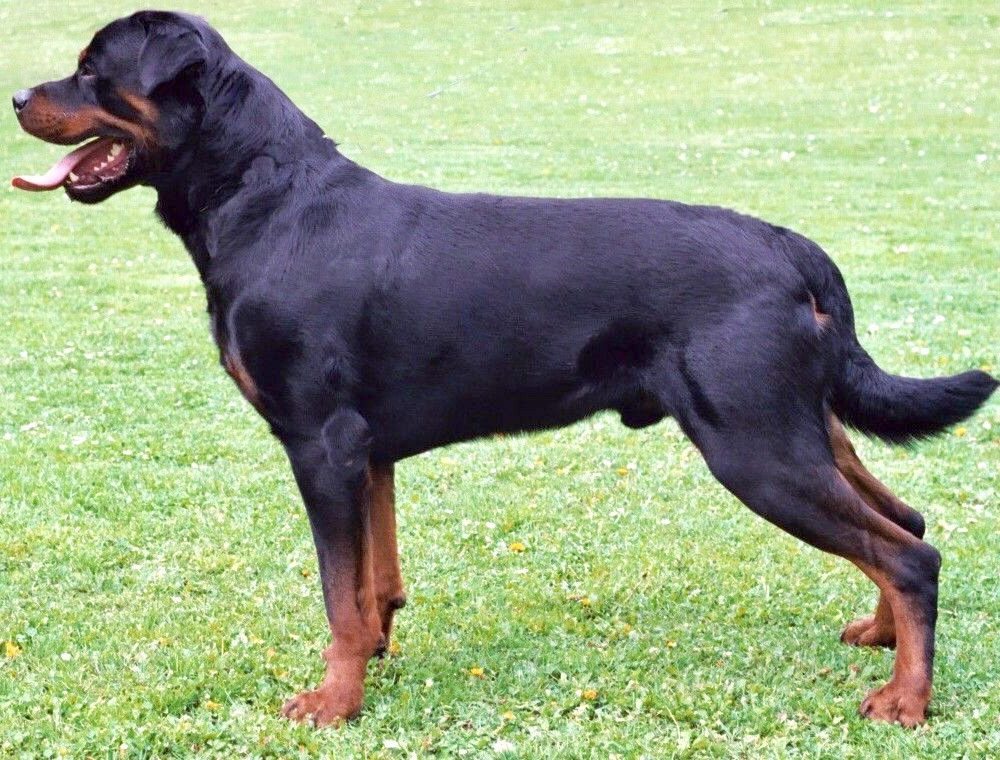
Photo: Dr. Manfred Herrmann Allgemeiner Deutscher Rottweiler-Klub (ADRK) e.V. http://www.ADRK.de · CC BY-SA 3.0 · Wikimedia

Also known as Rott, Rottie, and Standard Rottweiler.

The record of the breed

The Rottweiler, as measured

19 questions a club or an owner would ask. 10 are answered, each with its source and the sentence it comes from. 4 were read from a paper and wait for a person's review. 1is answered elsewhere on this page. 4 have no answer here yet, and each one says who holds the data.

Health, measured

  1. How long do they live?
    9 years Rottweiler longevity
    median · cohort of 5,321 · 5,321 Rottweilers under primary veterinary care in the UK · 2013

    This is the median age at death among the dogs in this study that died. The life expectancy at the top of the page comes from a different study and a different measure, a life table, so the two numbers are not expected to match.

    The sentence it comes from
    The median longevity of Rottweilers overall was 9.0 years (IQR 7.2–10.5, range 0.0–17.0).
  2. What share of recorded deaths is cancer?
    33% Neoplasia: Overall Count (%)
    share of deaths · 103 of 312 · 5,321 Rottweilers under primary veterinary care in the UK · 2013
    The sentence it comes from
    Table 2 (Mortality in Rottweilers with a recorded cause of death under primary-care veter, n = 312): Grouped-level disorder: Neoplasia; Overall Count (%): 103 (33.0); Female count (%): 52 (32.1); Male Count: 51 (34); P-Value male vs female: 0.690
  3. What do they die of, and out of how many dogs?

    33% · Neoplasia: Overall Count (%)

    The same measurement that answers "What share of recorded deaths is cancer?" above.

  4. How often are hips dysplastic among dogs submitted to OFA?
    21.1% Hips: Dysplastic
    prevalence · of 109,013 · dogs submitted to OFA for Hips evaluation
    The sentence it comes from
    OFA HIPS: Breed: ROTTWEILER; Rank: 49; # Evaluations: 109,013; Normal %: 76.9; Excellent %: 9.0; Good %: 52.2; Fair %: 15.6; Dysplastic %: 21.1; Mild %: 10.7; Moderate %: 8.9; Severe %: 1.5
  5. How often are elbows abnormal among dogs submitted to OFA?
    38.8% Elbow: Abnormal
    prevalence · of 27,411 · dogs submitted to OFA for Elbow evaluation
    The sentence it comes from
    OFA ELBOW: Breed: ROTTWEILER; Rank: 3; # Evaluations: 27,411; Normal %: 60.8; Abnormal %: 38.8; Grade 1 %: 29.8; Grade 2 %: 7.8; Grade 3 %: 1.2
  6. Which disorders are most common, counted in a known group of dogs?
    7.46% Aggression: Overall prevalence %
    prevalence · 164 of 2,197 · 5,321 Rottweilers under primary veterinary care in the UK · 2013
    The sentence it comes from
    Table 3 (Prevalence of the most common disorders at a fine-level of diagnostic precision , n = 2197): Fine-level disorder: Aggression; Count: 164; Overall prevalence %: 7.46; 95% CIa: 6.40–8.64; Female prevalence %: 5.47; Male prevalence %: 9.36; P-Value*: 0.001
  7. Which body system is most often affected, counted in a known group of dogs?
    12.01% Musculoskeletal: Overall prevalence
    prevalence · 264 of 2,197 · 5,321 Rottweilers under primary veterinary care in the UK · 2013
    The sentence it comes from
    Table 4 (Prevalence of the most common grouped-level disorders recorded in Rottweilers (n, n = 2197): Grouped-level disorder: Musculoskeletal; Count: 264; Overall prevalence: 12.01; 95% CIa: 10.69–13.45; Female prevalence: 12.34; Male prevalence: 11.79; P-Value*I: 0.695
  8. What is the median adult bodyweight?
    99 lb (44.9 kg) Rottweiler adult bodyweight
    median · cohort of 5,321 · 5,321 Rottweilers under primary veterinary care in the UK · 2013
    The sentence it comes from
    The median adult bodyweight overall was 44.9 kg (IQR 39.55–51.00, range 20.00–88.80).
  9. What are the insurer mortality and morbidity rates per 10,000 dog-years, by window?
    Not measured here yet

    Sources were opened and none of them answers this.

  10. What are the carrier frequencies for the breed's known variants?
    Answered on this page

    See the disease-variant table on this page, from Donner 2023.

  11. Which disease-risk haplotypes have been mapped in the breed, and at what frequency?
    Not measured here yet

    Not opened here yet. Who has measured it: Hedan et al. 2021, common predisposing loci to hematopoietic cancers in four dog breeds (PMID 33793571), data on Dryad doi:10.5061/dryad.hx3ffbgd4; the Rottweiler is one of the four; lane not yet built.

Identity and recognition

  1. When did the AKC recognize the breed?
    1931 American Kennel Club
    The sentence it comes from
    AKC: the Rottweiler was recognized by the American Kennel Club in 1931.
  2. When did the FCI accept the breed?
    1955 FCI
    The sentence it comes from
    FCI, Rottweiler: Date of acceptance on a definitive basis by the FCI 1/1/1955.
  3. What is the breed's population-genetic structure?
    Read, under review

    Read from Parker 2017 cladogram workbook: parker2017-mmc3.xlsx (2017), secondary prose. A person has not yet reviewed what the reader took from it, so the number waits.

  4. Which health tests do the registries require or recommend before breeding?
    Not measured here yet

    Sources were opened and none of them answers this.

Origin, as the sources claim it

  1. Where does the breed come from, as the registries and sources claim?
    Read, under review

    Read from FCI: Rottweiler nomenclature (No. 147) (2026), a registry fact. A person has not yet reviewed what the reader took from it, so the number waits.

  2. What is the earliest opened print source that names the breed?
    Read, under review

    Read from Geschichte und Beschreibung der Rassen des hundes. Unter Mitwirkung der namhaftesten Zuchter und Preisrichter und in Ueverinstimmung mit den officiell anerkannten Rassezeichen der massgebenden Vereine des In- und Auslandes (1894), a period source, dated. A person has not yet reviewed what the reader took from it, so the number waits.

Population

  1. Is the registered population rising or falling, by registry and year?
    Read, under review

    Read from Rottweilers under primary veterinary care in the UK: demography, mortality and disorders (2017), a peer-reviewed claim with no count of dogs behind it. A person has not yet reviewed what the reader took from it, so the number waits.

Temperament

  1. What do owner-reported behavior instruments say about the breed, with n?
    Not measured here yet

    Not opened here yet. Who has measured it: Darwin's Ark behavior factors (Morrill 2022); KoiraNet mental descriptions (Finnish Kennel Club).

Mendelian-disease genetics

Which disease variants turn up in Rottweilers?

From a panel of 250 Mendelian-disease variants screened in 1,054,293 dogs (Donner et al. 2023), 25 turn up in Rottweilers at observable frequency. The figure beside each is its allele frequency. Of the gene copies tested in this breed, the share that carry the variant. Every dog carries two copies, so this is not the share of dogs. It is not clinical risk. Most recessive variants require two copies for disease expression; many dominant variants show incomplete penetrance. Read this as a population fingerprint of what's in the gene pool, not a per-dog prediction.

low frequency band 6.8%
n = 4,713 dogs · 1 variant tested · OMIA:001432-9615 · omia.org →
RPGRIP1what this gene does

RPGRIP1 is a gene involved in the function of photoreceptor cells in the eye, which help dogs see in different light conditions.

For your dog: If your dog belongs to a breed known to carry RPGRIP1 mutations, it’s worth discussing with your vet to understand the risks and monitor eye health.

n = 4,667 dogs · 1 variant tested · OMIA:001970-9615 · omia.org →
RAB3GAP1what this gene does

RAB3GAP1 is a gene involved in nerve cell function, particularly in how cells communicate and maintain their structure.

For your dog: If your dog is one of the breeds known to carry this gene variant, it's worth discussing genetic testing with your vet to understand any potential risks.

low frequency band 3.0%
n = 4,718 dogs · 1 variant tested · OMIA:002152-9615 · omia.org →
Nonsyndromic hearing loss
Autosomal recessive
low frequency band 0.89%
n = 4,718 dogs · 1 variant tested · OMIA:002336-9615 · omia.org →
Degenerative Myelopathy (DM)
Autosomal recessive
low frequency band 0.59%
n = 4,718 dogs · 1 variant tested · OMIA:000263-9615 · omia.org →
SOD1what this gene does

SOD1 is a gene that helps protect cells from damage caused by harmful molecules called free radicals.

For your dog: If your dog is a carrier of SOD1 variants, it's worth discussing with your vet, but remember carrier status doesn't mean your dog will get the disease.

Dilated Cardiomyopathy risk factor (PDK4-related)
Multifactorial (OMIA); Autosomal dominant (Incomplete penetrance) (Donner 2023)
marker disputed 0.20%
n = 4,718 dogs · 2 variants tested · OMIA:000162-9615 · omia.org →
PDK4what this gene does

PDK4 helps regulate how cells use energy, especially in the heart muscle.

For your dog: If your dog is one of the breeds known to carry this gene, it’s worth discussing heart health with your vet, but being a carrier doesn’t mean your dog will develop disease.

Von Willebrand's Disease, Type 1 (vWD 1)
Autosomal (OMIA); Autosomal recessive (Donner 2023)
low frequency band 0.20%
n = 4,718 dogs · 1 variant tested · OMIA:001057-9615 · omia.org →
Hyperuricosuria (HUU)
Autosomal recessive
low frequency band 0.11%
n = 4,718 dogs · 1 variant tested · OMIA:001033-9615 · omia.org →
SLC2A9what this gene does

SLC2A9 is a gene that helps regulate uric acid levels in a dog's body. It plays a role in how the kidneys handle this substance.

For your dog: If your dog is one of the breeds known to carry this gene variant, it’s worth discussing with your vet to understand any potential urinary health concerns.

low frequency band <0.1%
n = 4,718 dogs · 3 variants tested · OMIA:000256-9615 · omia.org →
SLC3A1what this gene does

SLC3A1 is a gene that helps transport certain amino acids in the kidneys. It plays a key role in preventing the buildup of cystine, which can form stones.

For your dog: If your dog is from a breed known to carry SLC3A1 variants, it’s worth discussing cystinuria risks with your vet, especially if urinary issues arise.

Ichthyosis
Autosomal recessive
low frequency band <0.1%
n = 4,718 dogs · 1 variant tested · OMIA:001588-9615 · omia.org →
PNPLA1what this gene does

PNPLA1 is a gene involved in maintaining the skin's barrier by helping produce essential fats that keep the skin healthy and hydrated.

For your dog: If your dog is from a breed known to carry PNPLA1 variants and shows persistent dry, flaky skin, it's worth discussing with your vet to understand if genetics might be playing a role.

low frequency band <0.1%
n = 4,717 dogs · 1 variant tested · OMIA:001466-9615 · omia.org →
DNM1what this gene does

DNM1 is a gene that helps nerve cells communicate properly by managing how they send signals during muscle activity.

For your dog: If your dog belongs to one of the breeds known to carry this gene variant, it's worth discussing EIC with your vet, especially if your dog is very active or shows signs of weakness during exercise.

low frequency band <0.1%
n = 4,710 dogs · 1 variant tested · OMIA:001298-9615 · omia.org →
PRCDwhat this gene does

PRCD is a gene involved in the health of a dog's retina, the part of the eye that detects light and helps with vision.

For your dog: If your dog belongs to a breed known to carry PRCD changes, it's worth discussing eye health and potential genetic testing with your vet.

low frequency band <0.1%
n = 4,697 dogs · 1 variant tested · OMIA:000157-9615 · omia.org →
FGF4what this gene does

FGF4 influences leg length by affecting bone growth, leading to shorter legs in certain breeds.

For your dog: If your dog is from a breed known to carry this gene, it's worth discussing spinal health with your vet, but being a carrier doesn’t guarantee problems.

low frequency band <0.1%
n = 4,718 dogs · 1 variant tested · OMIA:001514-9615 · omia.org →
GDNFwhat this gene does

GDNF is a gene that helps support nerve cells, especially those involved in sensing pain and movement.

For your dog: If your dog is from a breed that can carry this gene change, it’s worth asking your vet about testing to understand any potential risks.

Cystinuria Type I-B (SLC7A9 p.A217T)
Autosomal dominant (OMIA); Autosomal recessive (Incomplete penetrance) (Donner 2023)
marker disputed <0.1%
n = 4,718 dogs · 2 variants tested · OMIA:001880-9615 · omia.org →
SLC7A9what this gene does

SLC7A9 is a gene that helps transport certain amino acids in the kidneys. It plays a role in how the body handles cystine, an amino acid that can form crystals.

For your dog: If your dog is a carrier, it’s worth discussing with your vet to monitor urinary health and catch any issues early.

Stargardt Disease
Autosomal recessive
Pathogenic low frequency band <0.1%
n = 4,718 dogs · 1 variant tested · OMIA:002179-9615 · omia.org →
ABCA4what this gene does

ABCA4 is a gene that helps manage the transport of molecules in the retina, the part of the eye responsible for vision.

For your dog: If your dog is from a breed known to carry ABCA4 variants, it's worth discussing eye health with your vet, especially as they age.

low frequency band <0.1%
n = 4,717 dogs · 1 variant tested · OMIA:002148-9615 · omia.org →
Shar-Pei Autoinflammatory Disease (SPAID)
Multifactorial (OMIA); Autosomal dominant (Incomplete penetrance) (Donner 2023)
low frequency band <0.1%
n = 4,718 dogs · 1 variant tested · OMIA:001561-9615 · omia.org →
MTBPwhat this gene does

MTBP is a gene involved in regulating inflammation in the body. It helps control how the immune system responds to triggers.

For your dog: If your dog is from a breed known to carry MTBP variants, it's worth discussing with your vet whether genetic testing or monitoring for inflammation-related issues makes sense.

low frequency band <0.1%
n = 4,716 dogs · 1 variant tested · OMIA:001374-9615 · omia.org →
low frequency band <0.1%
n = 4,718 dogs · 1 variant tested · OMIA:001444-9615 · omia.org →
BEST1what this gene does

BEST1 is a gene that helps maintain the health of the retina, the light-sensitive layer at the back of the eye. It plays a role in keeping the cells in the retina functioning properly.

For your dog: If your dog is from a breed known to carry BEST1 variants, it’s worth discussing retinal health with your vet, especially if you notice any vision changes.

Show the other 5, ordered after these by frequency band, then allele frequency.
Source: Donner J et al. 2023. Genetic prevalence and clinical relevance of canine Mendelian disease variants in over one million dogs. PLOS Genetics 19(2):e1010651 · Evidence: Limited (DTC ascertainment, tag-SNP proxy) · Confounding MEDIUM · License CC-BY-4.0 · Phene IDs from OMIA (Sydney School of Veterinary Science, The University of Sydney; DOI 10.25910/2AMR-PV70).
Sample size in this breed: 4,718 dogs from the Donner 2023 cohort.

Which Mendelian variants matter most for Rottweilers?

The Mendelian-disease table above lists variants screened in 4,718 Rottweilers (Donner 2023). Five appear at 0.5% allele frequency or more: cone-rod dystrophy, POANV, neuroaxonal dystrophy, hearing loss and degenerative myelopathy (Donner 2023). All are recessive or incompletely penetrant; none dominates the breed’s health calculus the way ichthyosis does in Goldens. The highest-frequency variants are still uncommon, and because these are recessive or incompletely penetrant, carrying one is usually a long way from a dog being affected.

Cone-Rod Dystrophy (cord1-PRA/crd4)

Cone-rod dystrophy is an autosomal-recessive retinal degeneration with incomplete penetrance, linked to a variant in RPGRIP1 (OMIA:001432-9615). It begins in the cone cells and can progress to the rods. How far it goes varies: some affected dogs keep useful vision late into life. The breeds OMIA’s record describes are others; nobody has published how the disease runs in Rottweilers yet.

The variant’s allele frequency among tested Rottweilers is 6.8% (Donner 2023, n=4,713). That is the highest allele frequency in the breed’s Mendelian panel. Testing is available through commercial labs and the Orthopedic Foundation for Animals (OFA).

Polyneuropathy with Ocular Abnormalities and Neuronal Vacuolation (POANV)

Polyneuropathy with Ocular Abnormalities and Neuronal Vacuolation in Rottweilers is a recessive neurological condition affecting nerve and retinal tissue. Affected dogs develop progressive hind-limb weakness and vision loss, typically in early life. The condition was first described in Rottweilers, in reports from 1997 to 1999 (OMIA:001970-9615).

The variant’s allele frequency among tested Rottweilers is 3.1% (Donner 2023, n=4,667). Testing is available. The condition is rare enough in the breed that most owners will not encounter it.

Neuroaxonal dystrophy in Rottweilers is a recessive neurological condition caused by a variant in VPS11. Affected dogs develop progressive neurological decline, with onset typically in young adulthood and mild progression (OMIA:002152-9615). The Donner 2023 cohort found phenotype confirmation in both dogs carrying two copies (n=2), too few to state a penetrance figure.

The variant’s allele frequency among tested Rottweilers is 3.0% (Donner 2023, n=4,718). Testing is available.

Nonsyndromic Hearing Loss

Nonsyndromic hearing loss in Rottweilers is a recessive form of deafness, identified first in this breed. Affected dogs have congenital or early-onset bilateral hearing loss unrelated to other systemic disease.

The variant’s allele frequency among tested Rottweilers is 0.89% (Donner 2023, n=4,718). This is a low-frequency variant in the breed. Testing is available through OFA and commercial canine genetics labs.

What should I feed a Rottweiler?

Feeding a Rottweiler well means accounting for the breed’s size, growth rate, and the emerging cardiac risk signal in the broader working-dog population. Rottweilers are large working dogs, with adult males typically weighing 95 to 135 pounds, which means the calcium-to-phosphorus ratio during the growth phase is the single most important food decision an owner makes.

Giant-breed puppies require controlled calcium and phosphorus. Excess calcium during rapid growth can cause developmental orthopedic disease and joint instability. The National Research Council recommends a calcium-to-phosphorus ratio between 1.1:1 and 2:1 for large-breed puppies (NRC 2006). A large-breed puppy formula that controls mineral levels and delivers moderate protein supports steady growth without accelerating skeletal problems. Adult Rottweilers benefit from continued attention to joint support, particularly given the breed’s size and the orthopedic load.

Weight management in adulthood prevents joint stress. Rottweilers do not have a documented high hip dysplasia rate in the Donner cohort, but the breed’s size and orthopedic load mean excess weight is costly. A moderate-protein, controlled-calorie maintenance diet that keeps adult dogs in lean body condition supports longevity and quality of life.

What we don’t know

The Rottweiler atlas contains 183 dogs, a solid sample for a large-breed specialty cohort but smaller than the Golden Retriever Lifetime Study (Morris Animal Foundation, morrisanimalfoundation.org/golden-retriever-lifetime-study). The allele frequencies for the rarer variants (degenerative myelopathy, von Willebrand’s Disease Type 1, hyperuricosuria) rest on small numbers of at-risk dogs; confidence intervals are wide.

Cited life expectancy is 10.6 years (McMillan 2024 / VetCompass, n=6,275, 95% CI 10.4 to 10.7).

Frequently asked questions about Rottweilers

What is the most common genetic disease in Rottweilers? Cone-rod dystrophy has the most frequent variant on the tested panel: 6.8% allele frequency among tested Rottweilers (Donner 2023, n=4,713), a count of gene copies, not dogs. Its penetrance is incomplete, and some affected dogs keep useful vision late into life.

How long do Rottweilers live? The cited life expectancy is 10.6 years (McMillan 2024 / VetCompass). Breed-club estimates typically cite 8 to 11 years. Large and giant breeds have shorter lifespans than smaller dogs due to the metabolic cost of size.

Should I do a DNA test on my Rottweiler? For breeding stock, a panel covering the five measurable variants (cone-rod dystrophy, POANV, neuroaxonal dystrophy, hearing loss, and degenerative myelopathy) is the practical standard. For a pet, testing is optional unless you have concerns about a specific condition.

Are Rottweilers prone to heart disease? The breed does not show high prevalence of dilated cardiomyopathy in the current data. Genetic relatives such as Leonberger and Saint Bernard carry known DCM risk variants, and a taurine-adequate, grain-inclusive diet is a reasonable precaution. A diet that avoids grain-free formulations and ensures adequate taurine is a reasonable precaution.

What should I feed my Rottweiler puppy? A large-breed puppy formula with controlled calcium and phosphorus (calcium-to-phosphorus ratio between 1.1:1 and 2:1) is essential for healthy skeletal development (NRC 2006). Avoid excessive protein and mineral supplementation.

Are Rottweilers good with children? Rottweilers are large, powerful dogs that require early socialization and training. Their size and strength demand owner responsibility and supervision around children. Temperament varies; individual dogs matter more than breed generalizations.

Do Rottweilers shed a lot? Yes. Rottweilers have a double coat and shed heavily. Regular brushing during shedding season reduces loose hair in the home and skin issues.

What is the Rottweiler’s typical adult size? Males typically weigh 95 to 135 pounds; females 80 to 100 pounds (AKC breed standard). They are among the larger working breeds, which shapes their nutritional and exercise needs.

Names & origins

Other names

The Rottweiler is also recorded as Rott, Rottie, and Standard Rottweiler.

Identified as Rottweiler (VBO:0201143) in the Vertebrate Breed Ontology (Mullen et al. 2025, CC-BY 4.0) · registry IDs FCI 147 · iDog 205 · VeNom 14638.

For researchers Population genetics, disease models and every recorded condition Open the research detail for the Rottweiler
What the atlas says about Rottweiler

In the atlas, the Rottweiler clusters consistently as Rottweiler (100% of the 183 dogs here).

Genetic dimensions · CanVAS atlas

What the atlas genotypes say about Rottweiler

Computed from the 14,478 CanVAS dogs in the Atlas, on an imputed genotype backbone: 77,215 directly typed sites per dog, imputed to 9.67 million variants.

The confidence below counts dogs, not reads: it is the size of the sample, and it is separate from how the genotypes were measured.

Dogs behind these figures
183Founders
82 from Hayward2016, 59 from Hedan, 17 from Chen
Genetic diversity
0.28Tight
Mean heterozygosity across the breed. 24th tightest of 107 ranked populations (22nd to 27th when its dogs are resampled).
What does genetic diversity mean?

How varied a breed's gene pool is — the share of gene spots where a typical dog of the breed carries two different versions rather than two identical ones.

How to read it: Higher = more diverse. Among well-sampled breeds it ranges roughly 0.22 (least diverse) to 0.33 (most diverse).

Diversity is a strength, not a verdict on any individual dog. Lower diversity means it's worth paying attention to recessive-risk testing — not that a dog is doomed.

Cluster structure
Splits into two genetic sub-populations
Intra-breed RMS distance: 22.15 · likely working/show-line, regional, or kennel lineage split.
What does within-breed variation mean?

How much individual dogs within the breed differ from each other genetically.

How to read it: Higher = more internal variety among individuals of the breed.

Sensitive to how many dogs of the breed we've sampled.

Related breeds
Gave rise to
In the Working group
Explore the full lineage map →
VBO foundation stock (breeding records) · AKC breed group
Relatedness is documented lineage + kennel family. Genetic-ancestry distance measures diversity, not kinship, so it isn't used here.
How long they live
10.6years (life expectancy)
95% CI 10.4–10.7 · VetCompass, McMillan 2024, n=6,275. source
What does typical lifespan mean?

The median age dogs of the breed tend to reach.

How to read it: Higher = longer-lived. Compare to longevity-for-size to see whether it's just a size effect.

Drawn from population lifespan records; individual dogs vary widely with care, genetics, and luck.

n = 183 dogs · high sample · CanVAS (Brundage 2026) · Sniff Atlas
Comparative oncology

Rottweilers are a natural model for human cancer.

Some cancers appear in Rottweilers and in people driven by the same somatically-altered genes, cohort by cohort and cited on both sides. That makes this breed part of how we understand, and one day treat, the human disease. This is not a prediction about your dog, it is a window into the biology we share.

A gift to human medicine

Rottweilers are a natural model for human disease

Because the same genes cause the same conditions across species, the inherited conditions documented in Rottweilers help researchers understand, and work toward treating, the human diseases they model. This is the dog advancing human medicine. The breed models the human disease; it does not have it, and this is not a prediction for your dog.

  • amyotrophic lateral sclerosis type 1, modeled by the breed's Degenerative myelopathy via SOD1, the same underlying biology.
  • hemophilia B, modeled by the breed's Haemophilia B via F9, the same underlying biology.
  • OMIM:191170, modeled by the breed's Histiocytosis, malignant via TP53, the same underlying biology.
  • Krabbe disease, modeled by the breed's Krabbe disease via GALC, the same underlying biology.
  • Duchenne muscular dystrophy, modeled by the breed's Muscular dystrophy, Duchenne type via DMD, the same underlying biology.
  • narcolepsy 1, modeled by the breed's Narcolepsy via HCRTR2, the same underlying biology.
Human equivalents via OMIA → Mondo / OMIM. Model-of, not identity. The named gene is the canine locus, not a claim that a pet has the human disease.
Documented in OMIA

Every condition recorded in the Rottweiler

Beyond the testable carriers above, OMIA's literature catalogue records 28 genetic conditions in the Rottweiler, 21 of which have a known human equivalent. This is the documented landscape across all Rottweilers ever studied, not a prediction for any one dog.

Plus 10 more conditions recorded in the Rottweiler in OMIA.

Online Mendelian Inheritance in Animals (OMIA); Nicholas, Tammen & Sydney Informatics Hub, DOI 10.25910/2AMR-PV70
Documented in the breed's literature is not carrier status and not a forecast for an individual dog. Human equivalents are mapped via Mondo/OMIM. Allele frequencies (above) are the separately-measured testable subset (Donner 2023).
The data behind this page

Where every number on this page came from.

This page draws on three primary data sources. Allele frequencies for the Mendelian section come from Donner et al. 2023 (CC-BY-4.0). We grade these data at evidence Limited because the cohort is a direct-to-consumer ascertainment, which biases toward owners who chose to test their dogs. The panel also uses tag-SNP proxies for some variants rather than direct causal-variant assays. Limited is a study-design grade, not a quality grade: the Donner cohort is the largest open canine-genotype dataset in existence and we are grateful for it. We rate the confounding MEDIUM.

Population-genetic dimensions (heterozygosity, intra-breed PCA distance, nearest neighbors, trait-locus frequencies) come from CanVAS (Brundage 2026), harmonized through the Sniff Atlas. The exact release date and verification commit are pinned at the bottom of the page so a researcher can trace a number back to a specific snapshot. The disease-gene-variant graph comes from OMIA (Online Mendelian Inheritance in Animals; Nicholas, Tammen, and the Sydney Informatics Hub at the Sydney School of Veterinary Science, The University of Sydney; retrieved April 2026, DOI 10.25910/2AMR-PV70).

What this page does not yet have. Inheritance modes and per-disease penetrance evidence from Donner 2023 are in the structured data for every variant the panel covers. Mondo, OMIM, Ensembl, and HGNC cross-references live on the gene and disease pages this page links to, rather than being repeated here. What is still absent from this breed page is anything not in the cited panel, and each such gap carries its cause where it appears.

How to cite this page. The computed dimensions on this page are derived from the open Sniff Atlas v1.0.2 (Gehring 2026, doi:10.5281/zenodo.20566358, CC-BY 4.0). Full citation formats including BibTeX, RIS, and CITATION.cff at sniff.world/cite.

Some things about living with a rottweiler never make it into a database. Add what you know as a Keeper, in your words →

Lived experience, kept beside the science.
Add your rottweiler to the atlas

We have 203 rottweilers. We do not have yours.

Every rottweiler added sharpens the breed's genetic neighborhood. Enrollment is free. The data stays open. The star is permanent.

Want to wait for DNA uploads?

Leave your email and we'll let you know the moment DNA uploads open for Rottweilers.

References
  1. Donner J, Freyer J, Davison S, Anderson H, Blades M, Honkanen L, et al. (2023). Genetic prevalence and clinical relevance of canine Mendelian disease variants in over one million dogs. PLOS Genetics 19(2):e1010651. doi:10.1371/journal.pgen.1010651
  2. Brundage DM (2026). CanVAS: A Harmonized and Imputed Canine Variant Atlas. bioRxiv. doi:10.64898/2026.04.13.718238
  3. Nicholas, F.W., Tammen, I., & Sydney Informatics Hub. (2026). Online Mendelian Inheritance in Animals (OMIA) [dataset]. The University of Sydney. https://omia.org. doi:10.25910/2AMR-PV70 (retrieved April 2026).
Last updated
Sources: CanVAS (Brundage 2026) · Donner 2023 · OMIA