snıff

Chihuahua

Life expectancy
11.8 years
95% CI 11.5 to 11.9 · McMillan 2024, n=10,788
Highest allele frequency
Ehlers-Danlos Syndrome
9.8% of gene copies · 143 dogs tested · Donner 2023
Behind this page
25 dogs
behind the atlas figures · an early sketch · 4,273 tested for variants

Chihuahuas have a cited life expectancy of 11.8 years (McMillan 2024 / VetCompass, n=10,788, 95% CI 11.5 to 11.9). The tested variant with the highest allele frequency is Ehlers-Danlos Syndrome, at 9.8% among the 143 Chihuahuas tested (Donner 2023; gene copies, not dogs), then Chondrodystrophy and Intervertebral Disc Disease Risk (6.1%) and Cone-Rod Dystrophy (3.9%). 25 dogs stand behind the atlas figures here, so treat this page as an early sketch.

Chihuahua
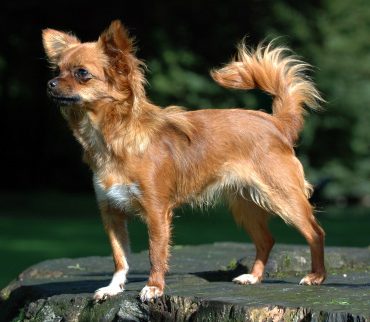
Photo: Bonnie van den Born, http://www.bonfoto.nl. The original uploader was Cwazi at Dutch Wikipedia. · CC BY-SA 3.0 · Wikimedia

Also known as Chi and chihuahueno.

Mendelian-disease genetics

Which disease variants turn up in Chihuahuas?

From a panel of 250 Mendelian-disease variants screened in 1,054,293 dogs (Donner et al. 2023), 41 turn up in Chihuahuas at observable frequency. The figure beside each is its allele frequency. Of the gene copies tested in this breed, the share that carry the variant. Every dog carries two copies, so this is not the share of dogs. It is not clinical risk. Most recessive variants require two copies for disease expression; many dominant variants show incomplete penetrance. Read this as a population fingerprint of what's in the gene pool, not a per-dog prediction.

high frequency band 6.1%
n = 4,246 dogs · 1 variant tested · OMIA:000157-9615 · omia.org →
FGF4what this gene does

FGF4 influences leg length by affecting bone growth, leading to shorter legs in certain breeds.

For your dog: If your dog is from a breed known to carry this gene, it's worth discussing spinal health with your vet, but being a carrier doesn’t guarantee problems.

Ehlers-Danlos Syndrome
Autosomal recessive
low frequency band 9.8%
n = 143 dogs · 1 variant tested · OMIA:002203-9615 · omia.org →
TNXBwhat this gene does

TNXB is a gene that helps produce a protein important for connective tissue, which supports skin, joints, and other structures in the body.

For your dog: If your dog is from a breed known to carry TNXB variants, it's worth discussing with your vet, especially if you notice unusual joint flexibility or skin issues.

low frequency band 3.9%
n = 4,268 dogs · 1 variant tested · OMIA:001432-9615 · omia.org →
RPGRIP1what this gene does

RPGRIP1 is a gene involved in the function of photoreceptor cells in the eye, which help dogs see in different light conditions.

For your dog: If your dog belongs to a breed known to carry RPGRIP1 mutations, it’s worth discussing with your vet to understand the risks and monitor eye health.

Degenerative Myelopathy (DM)
Autosomal recessive
low frequency band 1.5%
n = 4,273 dogs · 1 variant tested · OMIA:000263-9615 · omia.org →
SOD1what this gene does

SOD1 is a gene that helps protect cells from damage caused by harmful molecules called free radicals.

For your dog: If your dog is a carrier of SOD1 variants, it's worth discussing with your vet, but remember carrier status doesn't mean your dog will get the disease.

Dilated Cardiomyopathy risk factor (PDK4-related)
Multifactorial (OMIA); Autosomal dominant (Incomplete penetrance) (Donner 2023)
marker disputed 1.4%
n = 4,273 dogs · 2 variants tested · OMIA:000162-9615 · omia.org →
PDK4what this gene does

PDK4 helps regulate how cells use energy, especially in the heart muscle.

For your dog: If your dog is one of the breeds known to carry this gene, it’s worth discussing heart health with your vet, but being a carrier doesn’t mean your dog will develop disease.

low frequency band 1.0%
n = 4,264 dogs · 1 variant tested · OMIA:001298-9615 · omia.org →
PRCDwhat this gene does

PRCD is a gene involved in the health of a dog's retina, the part of the eye that detects light and helps with vision.

For your dog: If your dog belongs to a breed known to carry PRCD changes, it's worth discussing eye health and potential genetic testing with your vet.

Von Willebrand's Disease, Type 1 (vWD 1)
Autosomal (OMIA); Autosomal recessive (Donner 2023)
low frequency band 0.69%
n = 4,273 dogs · 1 variant tested · OMIA:001057-9615 · omia.org →
Primary Lens Luxation (PLL)
Autosomal recessive
Pathogenic low frequency band 0.43%
n = 4,273 dogs · 2 variants tested · OMIA:000588-9615 · omia.org →
ADAMTS17what this gene does

ADAMTS17 is a gene that influences body size and also plays a role in certain eye conditions. It affects the structure of tissues in the eye and elsewhere in the body.

For your dog: If your dog belongs to a breed known to carry ADAMTS17 variants, it’s worth discussing genetic testing and eye exams with your vet to stay ahead of potential issues.

Full ADAMTS17 gene page →
Bald Thigh Syndrome
Autosomal recessive
low frequency band 0.35%
n = 143 dogs · 1 variant tested · OMIA:002168-9615 · omia.org →
IGFBP5what this gene does

IGFBP5 is a gene that helps regulate growth factors involved in tissue development and repair.

For your dog: If you have a sighthound, it’s worth mentioning IGFBP5-related risks to your vet, but being a carrier doesn’t mean your dog will develop the syndrome.

low frequency band 0.30%
n = 4,273 dogs · 1 variant tested · OMIA:002198-9615 · omia.org →
low frequency band 0.29%
n = 4,273 dogs · 1 variant tested · OMIA:000247-9615 · omia.org →
low frequency band 0.26%
n = 4,273 dogs · 3 variants tested · OMIA:000256-9615 · omia.org →
SLC3A1what this gene does

SLC3A1 is a gene that helps transport certain amino acids in the kidneys. It plays a key role in preventing the buildup of cystine, which can form stones.

For your dog: If your dog is from a breed known to carry SLC3A1 variants, it’s worth discussing cystinuria risks with your vet, especially if urinary issues arise.

Cystinuria Type I-B (SLC7A9 p.A217T)
Autosomal dominant (OMIA); Autosomal recessive (Incomplete penetrance) (Donner 2023)
marker disputed 0.23%
n = 4,272 dogs · 2 variants tested · OMIA:001880-9615 · omia.org →
SLC7A9what this gene does

SLC7A9 is a gene that helps transport certain amino acids in the kidneys. It plays a role in how the body handles cystine, an amino acid that can form crystals.

For your dog: If your dog is a carrier, it’s worth discussing with your vet to monitor urinary health and catch any issues early.

low frequency band 0.14%
n = 4,271 dogs · 1 variant tested · OMIA:001962-9615 · omia.org →
low frequency band 0.12%
n = 4,273 dogs · 1 variant tested · OMIA:001466-9615 · omia.org →
DNM1what this gene does

DNM1 is a gene that helps nerve cells communicate properly by managing how they send signals during muscle activity.

For your dog: If your dog belongs to one of the breeds known to carry this gene variant, it's worth discussing EIC with your vet, especially if your dog is very active or shows signs of weakness during exercise.

Prekallikrein Deficiency
Autosomal recessive
low frequency band 0.11%
n = 4,273 dogs · 1 variant tested · OMIA:000819-9615 · omia.org →
KLKB1what this gene does

KLKB1 is a gene that helps produce prekallikrein, a protein involved in blood clotting and inflammation.

For your dog: If your dog is from a breed known to carry KLKB1 variants, it's worth asking your vet about blood clotting tests, especially before surgeries.

Macrothrombocytopenia
Autosomal recessive
low frequency band <0.1%
n = 4,273 dogs · 1 variant tested · OMIA:002434-9615 · omia.org →
TUBB1what this gene does

TUBB1 is a gene that helps make the building blocks of platelets, which are tiny blood cells important for clotting. It plays a key role in keeping platelet size and number normal.

For your dog: If your dog is from one of the breeds known to carry TUBB1 variants, it’s worth mentioning to your vet, especially before surgeries or if you notice unusual bleeding.

Collie Eye Anomaly (CEA)
Autosomal recessive
low frequency band <0.1%
n = 4,273 dogs · 1 variant tested · OMIA:000218-9615 · omia.org →
NHEJ1what this gene does

NHEJ1 is a gene involved in repairing breaks in DNA, helping maintain the integrity of genetic information in cells.

For your dog: If your dog belongs to one of the breeds known to carry this gene variant, it's worth discussing testing with your vet to understand any potential eye health risks.

Skeletal Dysplasia 2 (SD2)
Autosomal recessive
low frequency band <0.1%
n = 4,273 dogs · 1 variant tested · OMIA:001772-9615 · omia.org →
COL11A2what this gene does

COL11A2 is a gene that helps produce a type of collagen important for healthy bones and cartilage.

For your dog: If your dog is from a breed known to carry COL11A2 variants, it's worth discussing genetic testing with your vet to understand any risks.

n = 4,273 dogs · 2 variants tested · OMIA:002089-9615 · omia.org →
Show the other 21, ordered after these by frequency band, then allele frequency.
Source: Donner J et al. 2023. Genetic prevalence and clinical relevance of canine Mendelian disease variants in over one million dogs. PLOS Genetics 19(2):e1010651 · Evidence: Limited (DTC ascertainment, tag-SNP proxy) · Confounding MEDIUM · License CC-BY-4.0 · Phene IDs from OMIA (Sydney School of Veterinary Science, The University of Sydney; DOI 10.25910/2AMR-PV70).
Sample size in this breed: 4,273 dogs from the Donner 2023 cohort.
In plain terms

What these results mean for a Chihuahua

About 6 in every 100 copies of this gene in the 4,246 Chihuahuas tested carry this change (Donner 2023).

  • Extra copies of a growth gene called FGF4 shape a dog's legs and back. The copy on chromosome 12 is the one linked to disc disease. The copy on chromosome 18 makes legs shorter.
    OMIA 000157-9615

    “Two FGF4 retrogenes (FGF4L1 on chromosome 18 and FGF4L2 on chromosome 12) have been identified to cause dwarfism across many dog breeds.” OMIA 000157-9615

    “Brown et al. (2017) reported that an FGF4 retrogene insertion in chromosome CFA12” OMIA 000157-9615

  • Carrying it raises the risk, but it can't tell you which dog will have a disc problem. In Dachshunds, researchers found the test on its own isn't a reliable guide.
    OMIA 000157-9615

    “the FGF4 retrogene insertion on CFA12 is not a valid risk indicator on its own” OMIA 000157-9615

What to do
Ask your vet what the result means for your dog. The sources here don't say what lowers the risk for a dog that carries it.

Not tested, or a mix
Without a test, no one can tell. Short legs don't tell you either: the disc copy and the short-leg copy are different.

About 2 in every 100 copies of this gene in the 4,273 Chihuahuas tested carry this change (Donner 2023).

  • DM slowly damages the spinal cord in adult dogs, until the back legs stop working. Nothing yet can stop it.
    OMIA 000263-9615

    “This is an adult onset degeneration of the spinal cord that progresses to paraplegia and tetraparesis. There is no successful treatment. A genetic test is available.” OMIA 000263-9615

  • Two copies of the SOD1 gene change mean a dog is at risk, not that it will get sick. Some dogs with two copies never do.
    OMIA 000263-9615

    “some homozygous mutant dogs had no signs of degenerative myelopathy, which suggests incomplete penetrance or other causative loci” OMIA 000263-9615

  • One copy makes a dog a carrier. In the study that found this change, every dog with DM that was tested had two copies.
    OMIA 000263-9615

    “All affected dogs tested were homozygous mutant.” OMIA 000263-9615

What to do
A DNA result isn't a diagnosis. If the way your dog walks changes, take that and the result to your vet.

Not tested, or a mix
Without a test, no one can tell how many copies your dog has. How common it is in a breed says nothing about one dog.

About 1 in every 100 copies of this gene in the 4,273 Chihuahuas tested carry this change (Donner 2023).

  • This gene change was linked to a heart disease called DCM in Dobermans, but it hasn't been shown to cause it. The curated record says a test for it isn't a good guide to heart risk, even in Dobermans.
    OMIA 000162-9615

    “it is evident that any DNA test based on this marker will not be a good indicator of liability to this disorder in Dobermans” OMIA 000162-9615

What to do
A result for this one isn't, by itself, a reason for heart tests. Whether to check your dog's heart is a conversation to have with your vet.

Not tested, or a mix
Outside the Doberman, no one has shown what this change means.

Which Mendelian variants matter most for Chihuahuas?

Chihuahuas have among the most diverse gene pools of any ranked population in the atlas, mean heterozygosity 0.398, which means more unique alleles are shuffling in the population than in most breeds. Only 25 Chihuahuas stand behind the atlas figures, and 4,273 tested by Donner 2023 have shaped what we know. The Mendelian-disease table lists 194 variants screened, 41 at observable allele frequency. Six matter most by allele frequency and impact.

Ehlers-Danlos Syndrome (EDS)

Ehlers-Danlos Syndrome in Chihuahuas is an autosomal-recessive connective-tissue disorder discovered in the breed itself. Affected dogs have fragile skin and joints, abnormal wound healing, and tissue friability. Affected dogs need lifelong care of their skin and joints. The variant’s allele frequency among tested Chihuahuas is about 9.8% (Donner 2023, n=143). Let that settle: that is the highest allele frequency in the list, and the sample size is small enough that the real frequency in the population could be materially different. A single cohort of 143 animals may not represent the whole breed equally.

Testing exists but is not yet on most commercial panels. Contact breed-club health committees for current testing recommendations.

Cone-Rod Dystrophy (cord1-PRA/crd4)

Cone-rod dystrophy in Chihuahuas is an autosomal-recessive vision disorder with incomplete penetrance. Affected dogs lose cone function first (daytime vision), then rod function (night vision), and become blind. About the variant’s allele frequency among tested Chihuahuas is 3.9% (Donner 2023, n=4,268). The incomplete penetrance means not all dogs with two copies will develop confirmed clinical blindness.

Testing is available. Affected dogs adapt well to familiar environments.

How should I test my Chihuahua?

For breeding stock, a panel covering CDDY (FGF4), Ehlers-Danlos, dilated cardiomyopathy, cone-rod dystrophy, degenerative myelopathy, prcd-PRA, and Von Willebrand’s Disease Type 1 is reasonable. The sample sizes for some variants are small enough that future testing may refine these recommendations as more Chihuahuas are genotyped.

What should I feed a Chihuahua?

Chihuahuas typically weigh under 6 pounds at maturity per the AKC breed standard (akc.org/dog-breeds/chihuahua/), and their low muscle mass makes them prone to hypoglycemic drops when meals are skipped. The breed’s nutritional priorities are different from larger dogs: meal frequency, energy density, and the prevention of weight extremes (both obesity and dangerous thinness) shape the feeding strategy more than genetic vulnerabilities do.

The CDDY allele frequency (6.1%) is moderate enough that joint-protective feeding matters across the lifespan, even though the visible disc-disease phenotype is less common in Chihuahuas than in Dachshunds. A small-breed adult formula with controlled calcium and a balanced calcium-to-phosphorus ratio (NRC Nutrient Requirements of Dogs and Cats, 2006, Table 15-1 recommends a minimum Ca:P ratio near 1:1 with typical adult targets around 1.2:1) supports bone and joint health without the hypernutrition that causes rapid growth.

Meal frequency is the critical variable. Most adult Chihuahuas do best on two or three small meals per day rather than one large feeding. Hypoglycemia in toy breeds is a real risk when owners follow large-breed feeding schedules. A 5-pound Chihuahua missing breakfast faces a steeper blood-glucose drop than a 75-pound Labrador missing the same meal. The caloric intake should remain consistent, but the delivery pattern prevents the dangerous fasting intervals.

Weight management is breed-critical. Obesity in a 5-pound frame stresses the spine, joints, and heart much more acutely than it does in a larger dog. The Orthopedic Foundation for Animals does not publish breed-specific prevalence data for Chihuahuas, but excess weight in a small frame is widely recognized by veterinary clinicians as accelerating spinal and joint wear. Feed to a lean body condition score, not to satiation.

Chihuahuas fed puppy formulas need the same calcium discipline as larger breeds. A small-breed puppy formula with appropriate nutrient bounds prevents developmental orthopedic disease even at the smaller end of the growth spectrum.

What we don’t know

The sample size for genetic testing in Chihuahuas is small relative to larger breeds. Only 25 Chihuahuas built the atlas; 4,273 passed through Donner screening. That is not negligible, but the small atlas sample (25 dogs) means future testing may shift allele frequencies. Ehlers-Danlos was discovered in only 143 dogs tested, the real population frequency could differ substantially.

The penetrance landscape for Chihuahua-specific variants is incomplete. Cone-rod dystrophy and degenerative myelopathy both show incomplete penetrance, but the number of at-risk dogs who become phenotype-confirmed is still uncertain. We do not yet have solid estimates of what percentage of Chihuahuas with two copies of each variant actually develop disease.

Cardiac disease in Chihuahuas is common in breed conversations but not yet systematized in the published literature the way it is for Cavalier King Charles Spaniels. The honest summary is that owners report murmurs, arrhythmias, and congestive heart failure in middle-aged and elderly Chihuahuas, but we lack breed-club health-screening data comparable to what other breeds maintain.

Frequently asked questions about Chihuahuas

Are Chihuahuas good with children? Chihuahuas under 6 pounds are fragile and can be injured by rough handling. Older children and calm households work better than homes with toddlers. Adult supervision is always necessary.

How long do Chihuahuas live? Cited life expectancy is 11.8 years (McMillan 2024 / VetCompass, n=10,788, 95% CI 11.5 to 11.9). Some Chihuahuas live into their mid-to-late teens, though well-documented cases of dogs living past twenty are rare anecdotes rather than peer-reviewed findings.

What is the most common health problem in Chihuahuas? Dental disease is common in the breed because of crowded tooth structure in a tiny jaw. Heart disease, patellar luxation, and intervertebral disc disease are also frequent presentations.

Should I do a DNA test on my Chihuahua? For breeding stock, yes. A panel covering FGF4 (CDDY), Ehlers-Danlos, dilated cardiomyopathy, cone-rod dystrophy, degenerative myelopathy, prcd-PRA, and Von Willebrand’s Disease Type 1 is reasonable. For pet-owner curiosity, testing is lower-yield in Chihuahuas than in larger breeds with higher variant frequencies.

What is the best diet for a Chihuahua? Frequent small meals of a small-breed adult formula prevent hypoglycemia. Feed to lean body condition, not appetite. Avoid the common trap of free-feeding in this breed.

Are Chihuahuas prone to hypoglycemia? Yes. Missed meals can cause dangerous blood-glucose drops. Multiple small feedings per day, consistent timing, and high-quality small-breed formulas are preventive. Hypoglycemia is most common in puppies and in adult dogs during stress or illness.

Do Chihuahuas need special grooming? Smooth-coat Chihuahuas need minimal grooming. Long-coat Chihuahuas need regular brushing and ear cleaning to prevent mats and ear infections. Both coat types shed year-round.

Are Chihuahuas prone to patellar luxation? Yes. Patellar luxation (slipped kneecap) is common in toy breeds, including Chihuahuas. Affected dogs may skip a step or hold a hind leg up briefly. Severe cases need surgery. Weight management and controlled exercise reduce risk.

Temperament

What Chihuahuas tend toward

Tendencies from owner surveys of purebred Chihuahuas — a leaning across the breed, not a prediction for any one dog. A bar’s strength shows how much of that behavior breed actually explains: for most it’s faint, because the rest is your dog, their training, and the life you give them.

Agonistic Thresholdbreed ~9%
assertivediffident
Toy-directed Motor Patternsbreed ~18%
toy-directednot toy-directed
Dog Sociabilitybreed ~8%
less sociablehighly sociable
Human Sociabilitybreed ~11%
less sociablehighly sociable
Biddabilitybreed ~18%
biddableindependent
Proximity Seekingbreed ~13%
affectionatealoof
Arousal Levelbreed ~8%
arousedcomposed
Environmental Engagementbreed ~9%
high engagementlow engagement
n = 44 dogs · Morrill et al. 2022, Science, Darwin's Ark (CC0)
Owner-reported purebreds; each factor n ≥ 25. "Breed ~%" is the share of this behavior explained by breed.
Names & origins

Other names

The Chihuahua is also recorded as Chi and chihuahueno.

Identified as Chihuahua (VBO:0200338) in the Vertebrate Breed Ontology (Mullen et al. 2025, CC-BY 4.0) · registry IDs FCI 218 · iDog 71 · VeNom 7347.

For researchers Population genetics, disease models and every recorded condition Open the research detail for the Chihuahua
What the atlas says about Chihuahua

In the atlas, the Chihuahua clusters consistently as Chihuahua (100% of the 25 dogs here). Genetic diversity is high (mean heterozygosity 0.3979), reflecting either a mixed-breed cluster or breeds with broad genetic backgrounds.

Mean heterozygosity is 0.398, notably high, which indicates a broad genetic background. Only 25 dogs of this breed in the atlas, modestly sampled.

Life expectancy in the VetCompass cohort (McMillan 2024, n=10,788) is 11.8 years, about 2.3 years shorter than the atlas size trend predicts for the breed, one of the larger gaps in the atlas.

Genetic dimensions · CanVAS atlas

What the atlas genotypes say about Chihuahua

Computed from the 14,478 CanVAS dogs in the Atlas, on an imputed genotype backbone: 77,215 directly typed sites per dog, imputed to 9.67 million variants.

The confidence below counts dogs, not reads: it is the size of the sample, and it is separate from how the genotypes were measured.

Dogs behind these figures
25Founders
14 from Hayward2016, 10 from Spatola, 1 from JenkinsWGS
Genetic diversity
0.40Diverse
Mean heterozygosity across the breed. 1st most diverse of 107 ranked populations (1st to 6th when its dogs are resampled).
What does genetic diversity mean?

How varied a breed's gene pool is — the share of gene spots where a typical dog of the breed carries two different versions rather than two identical ones.

How to read it: Higher = more diverse. Among well-sampled breeds it ranges roughly 0.22 (least diverse) to 0.33 (most diverse).

Diversity is a strength, not a verdict on any individual dog. Lower diversity means it's worth paying attention to recessive-risk testing — not that a dog is doomed.

Cluster structure
Single tight cluster
Intra-breed RMS distance: 22.45
What does within-breed variation mean?

How much individual dogs within the breed differ from each other genetically.

How to read it: Higher = more internal variety among individuals of the breed.

Sensitive to how many dogs of the breed we've sampled.

Related breeds
Gave rise to
In the Toy group
Explore the full lineage map →
VBO foundation stock (breeding records) · AKC breed group
Relatedness is documented lineage + kennel family. Genetic-ancestry distance measures diversity, not kinship, so it isn't used here.
How long they live
11.8years (life expectancy)
95% CI 11.5–11.9 · VetCompass, McMillan 2024, n=10,788. source
What does typical lifespan mean?

The median age dogs of the breed tend to reach.

How to read it: Higher = longer-lived. Compare to longevity-for-size to see whether it's just a size effect.

Drawn from population lifespan records; individual dogs vary widely with care, genetics, and luck.

n = 25 dogs · moderate sample · CanVAS (Brundage 2026) · Sniff Atlas
A gift to human medicine

Chihuahuas are a natural model for human disease

Because the same genes cause the same conditions across species, the inherited conditions documented in Chihuahuas help researchers understand, and work toward treating, the human diseases they model. This is the dog advancing human medicine. The breed models the human disease; it does not have it, and this is not a prediction for your dog.

Human equivalents via OMIA → Mondo / OMIM. Model-of, not identity. The named gene is the canine locus, not a claim that a pet has the human disease.
Documented in OMIA

Every condition recorded in the Chihuahua

Beyond the testable carriers above, OMIA's literature catalogue records 21 genetic conditions in the Chihuahua, 18 of which have a known human equivalent. This is the documented landscape across all Chihuahuas ever studied, not a prediction for any one dog.

Plus 3 more conditions recorded in the Chihuahua in OMIA.

Online Mendelian Inheritance in Animals (OMIA); Nicholas, Tammen & Sydney Informatics Hub, DOI 10.25910/2AMR-PV70
Documented in the breed's literature is not carrier status and not a forecast for an individual dog. Human equivalents are mapped via Mondo/OMIM. Allele frequencies (above) are the separately-measured testable subset (Donner 2023).
The data behind this page

Where every number on this page came from.

This page draws on three primary data sources. Allele frequencies for the Mendelian section come from Donner et al. 2023 (CC-BY-4.0). We grade these data at evidence Limited because the cohort is a direct-to-consumer ascertainment, which biases toward owners who chose to test their dogs. The panel also uses tag-SNP proxies for some variants rather than direct causal-variant assays. Limited is a study-design grade, not a quality grade: the Donner cohort is the largest open canine-genotype dataset in existence and we are grateful for it. We rate the confounding MEDIUM.

Population-genetic dimensions (heterozygosity, intra-breed PCA distance, nearest neighbors, trait-locus frequencies) come from CanVAS (Brundage 2026), harmonized through the Sniff Atlas. The exact release date and verification commit are pinned at the bottom of the page so a researcher can trace a number back to a specific snapshot. The disease-gene-variant graph comes from OMIA (Online Mendelian Inheritance in Animals; Nicholas, Tammen, and the Sydney Informatics Hub at the Sydney School of Veterinary Science, The University of Sydney; retrieved April 2026, DOI 10.25910/2AMR-PV70).

What this page does not yet have. Inheritance modes and per-disease penetrance evidence from Donner 2023 are in the structured data for every variant the panel covers. Mondo, OMIM, Ensembl, and HGNC cross-references live on the gene and disease pages this page links to, rather than being repeated here. What is still absent from this breed page is anything not in the cited panel, and each such gap carries its cause where it appears.

How to cite this page. The computed dimensions on this page are derived from the open Sniff Atlas v1.0.2 (Gehring 2026, doi:10.5281/zenodo.20566358, CC-BY 4.0). Full citation formats including BibTeX, RIS, and CITATION.cff at sniff.world/cite.

Some things about living with a chihuahua never make it into a database. Add what you know as a Keeper, in your words →

Lived experience, kept beside the science.
Add your chihuahua to the atlas

We have 74 chihuahuas. We do not have yours.

Every chihuahua added sharpens the breed's genetic neighborhood. Enrollment is free. The data stays open. The star is permanent.

Want to wait for DNA uploads?

Leave your email and we'll let you know the moment DNA uploads open for Chihuahuas.

References
  1. Donner J, Freyer J, Davison S, Anderson H, Blades M, Honkanen L, et al. (2023). Genetic prevalence and clinical relevance of canine Mendelian disease variants in over one million dogs. PLOS Genetics 19(2):e1010651. doi:10.1371/journal.pgen.1010651
  2. Brundage DM (2026). CanVAS: A Harmonized and Imputed Canine Variant Atlas. bioRxiv. doi:10.64898/2026.04.13.718238
  3. Nicholas, F.W., Tammen, I., & Sydney Informatics Hub. (2026). Online Mendelian Inheritance in Animals (OMIA) [dataset]. The University of Sydney. https://omia.org. doi:10.25910/2AMR-PV70 (retrieved April 2026).
Last updated
Sources: CanVAS (Brundage 2026) · Donner 2023 · OMIA